
The Complete Guide to DJI Hasselblad Camera Technology
In 2017, DJI acquired a majority stake in Hasselblad, the Swedish camera manufacturer whose medium-format cameras have been trusted by professional photographers and even NASA astronauts for over seven decades. This strategic partnership has yielded a series of co-engineered camera systems that bring Hasselblad's legendary color science, optical precision, and imaging philosophy to DJI's aerial platforms. From the first Hasselblad-branded drone camera to the latest 6K system on the Mavic 4 Pro, this guide traces the evolution of a partnership that has fundamentally elevated what a drone camera can achieve.
The Foundation: Hasselblad Natural Colour Solution
At the core of every DJI-Hasselblad camera is the HNCS (Hasselblad Natural Colour Solution), a proprietary color calibration system developed over decades of medium-format camera manufacturing. HNCS maps the sensor's raw color response to a perceptually accurate color space that reproduces colors as the human eye sees them — skin tones that look natural and alive, vegetation that displays the subtle variations between species and health states, and skies that transition smoothly from deep blue zenith to warm horizon glow. Unlike the over-saturated, artificially punchy color profiles common in consumer cameras, HNCS prioritizes accuracy and subtlety, producing images that require minimal color correction and look naturally beautiful from the moment of capture.
Generation 1: Mavic 2 Pro (2018)
The Mavic 2 Pro introduced the first Hasselblad camera on a consumer DJI drone, pairing a 1-inch CMOS sensor with a 20MP resolution, adjustable aperture (f/2.8–f/11), and 10-bit Dlog-M color profile. For the first time, drone photographers had access to a camera system that rivaled dedicated ground-based cameras in color accuracy and dynamic range. The Mavic 2 Pro proved that Hasselblad's color science translated beautifully to aerial photography, establishing a new quality benchmark that competitors have struggled to match ever since.
Generation 2: Mavic 3 Series (2021-2023)
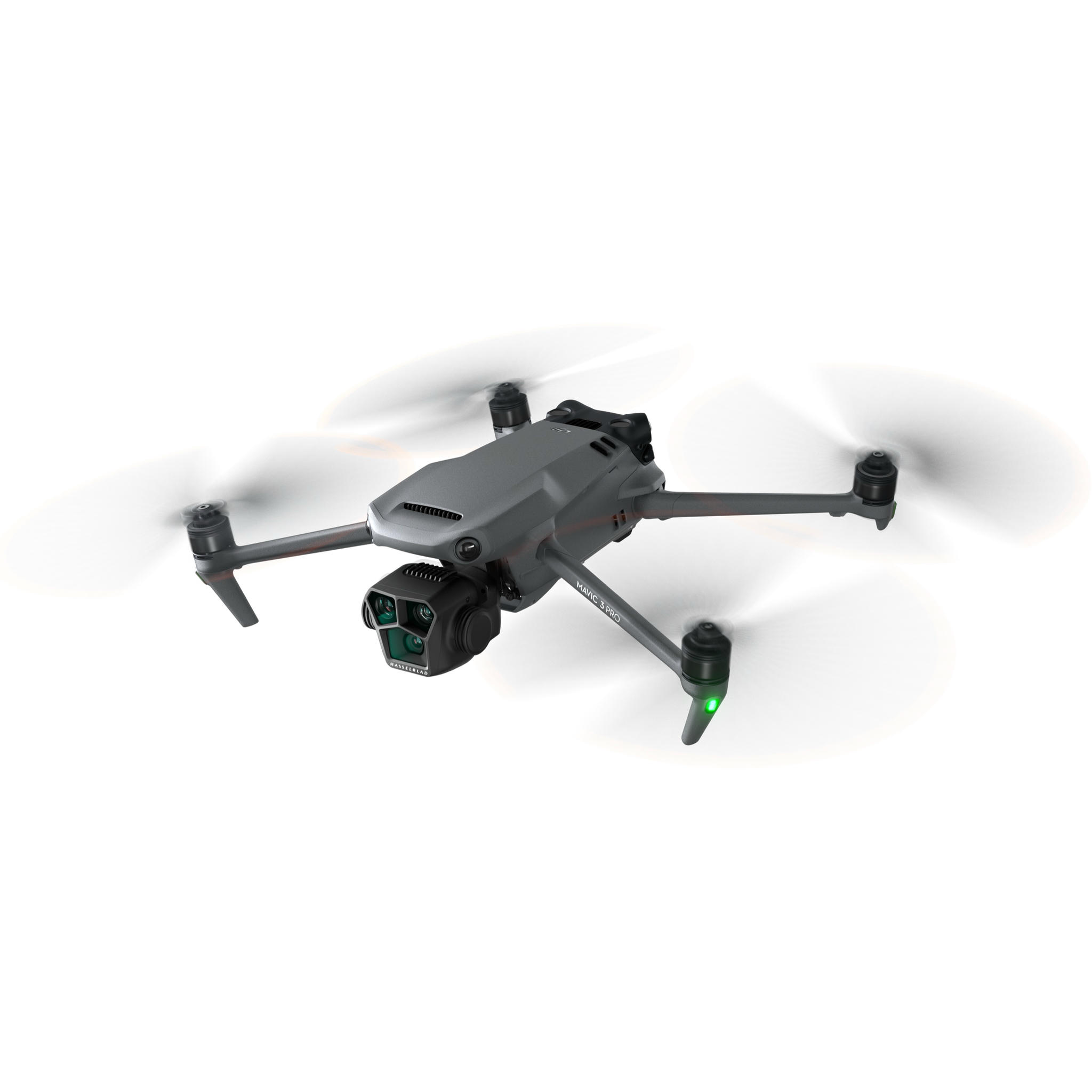
The Mavic 3 elevated the partnership to new heights with a 4/3 CMOS sensor — four times the surface area of the Mavic 2 Pro's 1-inch sensor — delivering 20MP stills and 5.1K/50fps video with 12.8 stops of dynamic range. The larger sensor captured more light per pixel, dramatically improving low-light performance and enabling cleaner images at high ISO settings. The Mavic 3 Pro (2023) expanded the system further with a triple-camera configuration: the 24mm Hasselblad main camera, a 70mm medium telephoto, and a 166mm periscope telephoto, giving creators unprecedented focal versatility in a single foldable platform. The Mavic 3 Classic offered the Hasselblad main camera without the telephoto lenses at a more accessible price point, demonstrating DJI's commitment to making Hasselblad quality available to a broader audience.
Generation 3: Mavic 4 Pro (2026)
The Mavic 4 Pro represents the current pinnacle of the DJI-Hasselblad partnership. The 4/3 CMOS sensor has been upgraded to support 6K/30fps video recording, and the HNCS processing pipeline has been refined with AI-assisted color mapping that adapts to scene content — optimizing skin tone rendering in portrait shots, enhancing foliage differentiation in landscape images, and preserving subtle architectural material textures in urban photography. The triple-lens system retains the 24mm/70mm/166mm focal range but improves optical quality across all three lenses, with reduced chromatic aberration, sharper edge performance, and more consistent color matching between cameras during multi-lens edits.
Hasselblad's Influence on DJI's Camera Culture
The partnership's impact extends beyond specifications and color profiles. Hasselblad's engineering philosophy — prioritizing image quality, color accuracy, and user experience over specification-sheet metrics — has permeated DJI's camera development culture. DJI's camera teams work alongside Hasselblad's optical engineers in Gothenburg, Sweden, co-developing lens formulas, sensor tuning profiles, and image processing algorithms. This collaboration has influenced the camera systems across DJI's entire product range, with HNCS-derived color science filtering down from the flagship Hasselblad cameras to the color pipelines of DJI's Air, Mini, and even Neo series cameras.
Looking Forward
Industry observers expect the DJI-Hasselblad partnership to continue pushing boundaries. Rumors of a medium-format sensor adaptation for the next Inspire series, computational photography advances leveraging Hasselblad's lens design expertise, and potential integration of Hasselblad's X System autofocus technology into gimbal-mounted cameras point to an exciting future where aerial photography quality approaches or matches the best ground-based camera systems available.
Experience Hasselblad quality from the sky. Contact DJI-ELITE to explore the full range of DJI drones featuring Hasselblad camera systems, compare models, or arrange a demonstration that will show you the difference Hasselblad color science makes in your aerial photography and videography.